Carolyn Polhemus Murder in Her Apartment
Presumed InnocentCarolyn Polhemus Murder in Her Apartment is the crime at the center of the investigation and trial. Carolyn was discovered in her apartment after failing to attend a morning meeting and a court call; the scene’s condition prompted an officer to suspect that the killing occurred during or as a result of a sexual assault. Evidence collected there, including a glass later associated with Rusty Sabich’s fingerprints, became part of the case against him.
Discovery and Initial Response
Carolyn was found at about 9:30 a.m. after missing an eight o’clock meeting and a nine o’clock court call. Her secretary contacted the building superintendent, who pushed the apartment door open, looked inside, and recognized that police were needed. Patrol officers summoned Harold Greer, the third officer at the scene.
Greer described both what he saw and the evidence technicians’ work under his direction. They collected fibers from Carolyn’s body and additional fibers from her skirt. He also described a glass found on the bar and watched as the technicians sealed it in a plastic packet. Its later significance would make the handling and whereabouts of the glass a point of dispute.
The Scene and the Investigative Theory
Greer’s first impression rested on several features together: the position of Carolyn’s body, the way it had been tied, signs of disturbance, and an open window above the fire escape. Based on those circumstances, he initially believed that Carolyn had been murdered in the course of, or as a result of, a sexual assault. His testimony presented this as an assessment made on first viewing the scene, not as a final determination of the crime’s circumstances.
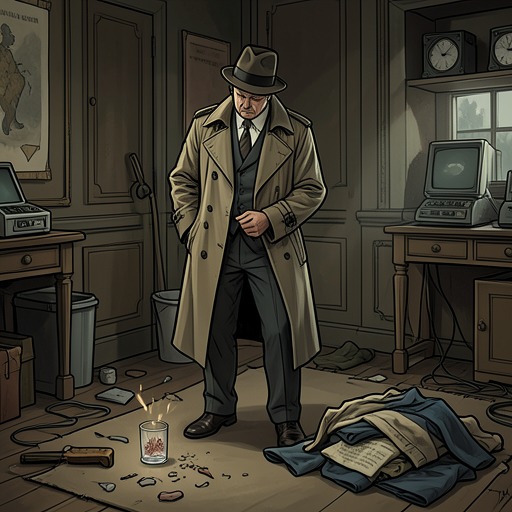
The apartment retained visible signs of the disturbance when Rusty later returned with the investigation. The table and mauve seating piece were still overturned, and an outline of Carolyn’s body had been marked on the floor near the kitchen. A small inlaid box Rusty had bought for her remained beside the sofa, a personal object amid the preserved traces of the crime. Its presence linked the evidence scene to their private history without resolving what had happened in the apartment.
Evidence and Aftermath
During that later visit, Rusty wore loose plastic gloves at Sandy Stern’s insistence, avoiding a potential dispute over fingerprints Tommy Molto said had already been found. Rusty counted twelve tumblers on a towel beside the bar, checking the number twice. His fingerprints had been identified on one of the glasses in that set. The count and the glass’s evidentiary history made the barware more than background detail: it connected the apartment investigation to contested questions about how evidence was collected and preserved.
The murder’s immediate discovery and the later scrutiny of the apartment thus occupy distinct stages of the case. Greer’s observations supplied an early theory about the circumstances of the killing, while the preserved scene and its objects became evidence revisited under the pressure of a prosecution. The testimony establishes what responders encountered and what they inferred at first; it does not, by itself, settle the killer’s identity or the full truth of the crime.